A plan to win
This guide is also available in PDF format.
1. Introduction
You have identified a BOND issue and you understand what is happening within your base. But that alone is not enough. People only truly get involved when they can clearly see how you plan to move together from a problematic situation toward a real solution. To explain that convincingly and to actually win, you need a plan to win. A plan to win not only helps you communicate the path to change; it also enables you to force that change. Designing a campaign in a deliberate, strategic way increases your chances of success, helps you bring more people along, and gives you a realistic, actionable roadmap toward victory. Organizing becomes powerful when problems are addressed through strategies grounded in the organizing method, strategies that turn the collective effort, time, and resources of activated people into the change they want to see. Within organizing, it is also essential that the people doing the work (the energized members of your base and the organizers supporting them) understand, support, and feel ownership over the plan. Only then does it truly become their plan to win.
2. Campaign phasesYou can build a campaign in phases. Each phase prepares you for the next and ensures that you enter the following stage stronger than before. Designing a campaign in phases also gives you the opportunity to create intentional pauses: periods of rest in which active members can recover from more intensive campaign moments, and in which you have time for evaluation, training, and other forms of learning. During these calmer periods, you can also prepare for the next phase of the campaign.3. Research
Preparing a campaign requires research. In addition to content-related research, you will need to explore questions such as: a. Who are my people?By defining which group of people you are organizing, you can better identify the opportunities and BOND issues that matter to them, and determine whether you have the capacity to involve this number of people. Do they share a common interest? Have they shown in the past that they are supportive? Are they people in a strategic position, because of who they are, or where they work or live, who can serve as an example to others? | b. Mapping the power structureHow is power organized around this issue? Which people, companies, and institutions have an interest in maintaining the status quo, and who benefits from a solution? Who influences whom? Which decision maker has the authority to resolve the specific problem you have identified? How might you play different actors off against each other? Who are your potential allies? Are there conflicting interests? What might be a viable pathway to influence these actors?c. Exploratory conversationsYou need to understand the circumstances, culture, values, and language used by the people you want to engage. What relationships, networks, or organisations exist among individuals within the target group that affect your ability to involve them? Where can they be found? How can they be approached? What is the group’s self-image? Based on this, you can make an initial assessment and adjust your narrative so it aligns more closely with their lived experience.d. What Are BOND Issues?See the BOND issue guide on our website. |
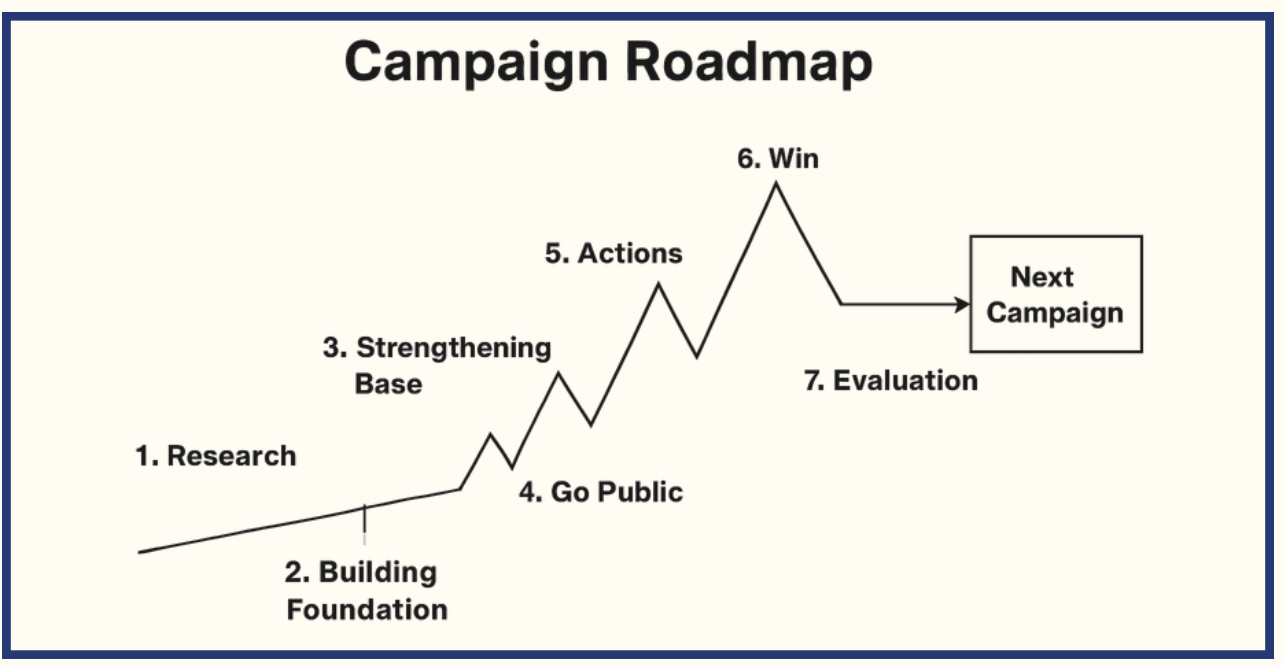
4. Building the baseBuilding a base starts with talking to people. One-on-one conversations with (potentially) a majority of your target group, in an environment where both conversation partners feel safe, such as in their home. As an organizer, your goal during these conversations is to speak as little as possible: you ask focused questions and practice active listening. Do people recognise themselves in the assumptions from your research phase? Do they describe the situation in the same way, or do they offer additional insights: for example about power dynamics surrounding the issue, or about how the BOND issue impacts the people around them? Is your conversation partner an informal leader, someone who is capable of mobilising others? Or do they know someone who is an informal leader and whom you really need to talk to? Is this a person who can bring others along because of their personality, knowledge, vision, or persuasive ability? Are they not only angry, but also able to build connections and work toward solutions? Often these are people who do not immediately say “yes” when you ask whether they want to be involved in your campaign. They are used to being asked to get involved in all kinds of things, so they want to make a careful assessment of whether participating is actually worth their time. Are people ready for action? Do they have the time, energy, and determination to become active within your organisation? Or are there personal circumstances that make this impossible? This is the moment when a conversation shifts from exploratory to activating. You have asked people what is wrong, now you ask whether things could be different, and what the cost would be of doing nothing. An activating conversation takes people from anger and frustration about a problem, to the hope that the problem can be solved, and finally to action. What can this (potential) activist do to help move the campaign closer to a solution? In the end, you want to bring together the people who are ready for action. This becomes the starting point of your group. You know some people will drop out, and new people will join later. For this early stage, it’s better to begin with a smaller group of strong, motivated people who keep things moving forward, rather than a large group with several people who slow things down. In this foundational phase, your goal is to help this group form a tight, cohesive team (see also: teams and structure). | 5. Strengthening the baseWith this first group of people, you want to start building a structure. How will they work together, communicate, and make decisions collectively? How do they fit into the broader structure of your organisation You want to intentionally develop a clear division of roles and responsibilities within this team. What roles or tasks allow each person to contribute in a meaningful way? Who is suited to lead this team, and who is willing to take on responsibility? And what is needed to further develop and support this leadership? At this stage, you need to strike a balance: on the one hand, coaching and supporting the group as the organizer, and on the other hand, not taking over the work of this emerging team. Likewise, you need to balance encouraging new active members to follow the plan and trust that it will work, with genuinely listening to your people: they will be the first to notice when the assumptions behind your plan to win no longer hold true. You also want to grow this team of active members by intentionally involving people from strategically important parts of your target group. That way, the team becomes a true reflection of the neighborhood or community you want to engage in your campaign. Bringing in diverse perspectives is never easy, because it also has to work alongside the differences between people. However, it ensures that you bring a variety of insights and experiences to the table and makes you less vulnerable to divide and-conquer tactics from opponents. |
6. Testing the structureA good way to find out if a new team of active members is ready for the campaign is a “structure test.” This involves giving the team a concrete task aimed at achieving a first measurable result within the campaign. For example, recruiting ten additional members for your organisation or carrying out a small action that tests the group’s willingness to act. The purpose of the test is to find out if all your assumptions about this team are correct. Are they willing to speak out publicly as activists? Are they indeed capable of mobilising others? By giving them a measurable goal with a clear deadline, it becomes possible to evaluate the test: Did they reach their goal, and if not, why? What is needed for them to succeed next time? A successful test also gives the team confidence, and as an organizer, you learn whether this team is ready for the next step. Another important part of strengthening the base is “inoculating” these beginning activists. Campaigns will always involve resistance from for example, supervisors, politicians, or influential people in their own circles. It is never without risk. No matter how carefully and thoughtfully your plan to win is designed, you will always face setbacks. At this stage, it is important to mentally prepare people, i.e., inoculate them, against the challenging aspects of participating in a campaign. This helps ensure they are not easily discouraged when obstacles arise. | 7. Going publicYou have brought the right people together. You know they are ready. They have been working behind the scenes to expand their base. Now your team of activists is strong enough. It is time to “go public”: to tell everyone in your neighborhood or community, and also your opponents, that your team is actively working on this issue. Choosing the right moment is crucial. Going public also means facing opposition, questions from people in their social networks, and a moment of taking a clear stance. That is why you want to make this choice consciously, and until then, continue working quietly behind the scenes. Going public can mean, for example, organising a meeting, openly collecting signatures, sending out a survey, or otherwise drawing attention to the issue you want to address first. It is also an opportunity to invite more people to join and become members of your organisation, and to build credibility through an initial campaign result. If significant opposition is expected, you may choose to delay going public, working under the radar and keeping things as confidential as possible until you have a larger group and can safely make your demands public. This could involve presenting the results of a petition or survey as a large group. The element of surprise, stepping out of the shadows suddenly and with impact, can give your team the advantage of taking the initiative in the new dynamic with your opponent. |
8. Building collective pressureTo build power through collective actions, you want to increase pressure step by step. You start with low-threshold actions that potential supporters can join with minimal time and risk, ideally giving them a taste of success. Each action or activity is also an opportunity to invite people to join and expand your group. Step by step, you convince more people of your plan to win. You can then organise the next action or activity, which increases pressure, involves more people, and may carry more risk. You might start with a petition, then organise a meeting, and only at the end have enough collective strength for a street action or other form of public demonstration. By planning this, you can bring people along at each step and signal to your opponent what your next escalation step will be if they refuse to negotiate a solution. Together with your team, you can brainstorm the next two or three escalating creative actions. If you need more than the usual build-up, you can select from dozens of action types and adapt them to the group’s needs (see the Tactical Star). This way, the group knows the direction you are heading and disappointments are avoided. If the first action is enough, great! If more is needed after one action, the group is already prepared for the next step. You just need to design the new action after the upcoming one. | 9. Achieving the WinYou will likely achieve your victory at the negotiation table or through a political decision. Negotiations and lobbying require significant capacity, time, and expertise. At the beginning of the escalation process, it is of course wise to formally present your demands and give your opponent the opportunity to do the right thing. But serious negotiation and lobbying become meaningful only when the pressure on your counterpart or the political actors is high enough. Only then will the other side be willing to grant you this success. Despite the expertise required for such negotiations and lobbying, it is important to ensure that the final result feels like a victory for everyone involved, not just the negotiators or lobbyists. This puts you in a position where negotiators or lobbyists must defend a compromise and answer to their base. Keep everyone engaged with regular updates, preferably through (online) meetings, or by involving as many active participants as possible in the campaign in negotiation or lobbying processes. |
10. Celebrating the WinBring together as many people as possible who were involved to celebrate what you have achieved together! Go over everything you did to make it happen. Make it a collective success. Thank everyone who contributed, and bring people along to your next campaign. A campaign victory is likely just one step in a larger strategy toward a better world. Claiming your victory can sometimes be tricky. Rarely will opponents implement your campaign demand 100% or publicly acknowledge that you have won. And you are certainly not the only factor or organisation that influenced a political decision or a company’s direction. The key question is often: have you gained enough to claim that you are closer to your campaign goal? And can you reasonably show that you contributed to moving the movement in the right direction? Do not be tempted to focus only on what is still wrong, or what your opponent is still doing incorrectly. That demotivates your people and allies, and builds the image of an organsation that cannot make an impact | 11. EvaluationAn evaluation is meant for learning together, both from what went well and from what could be done differently next time. If you have clearly formulated your goals in advance, and made them as measurable as possible, you can afterward accurately assess whether the campaign objectives were achieved. Think not only about content-related goals, but also goals such as the number of new members or activated supporters. A solid evaluation involves everyone who played a role in your campaign. This way, you can discover together what worked and what did not, and collectively decide how to approach the next campaign differently. It can also serve as the first step in the research phase of your next campaign, and should be a learning moment for everyone involved. Evaluations are also a good opportunity to train new leaders and involve them more deeply in your organisation. It is normal and healthy for your supporters to slow down after an action season, enjoy the improvements that have been achieved, and take time for other aspects of life that were temporarily on hold. Therefore, it is wise to proactively agree with your team on how to take breaks without the group collapsing, and to decide together how much rest to take before moving on to any new steps. This will also always be a moment when people may leave or move on to other things. |
12. Enforcement/ Implementation of the WinHopefully, you will not need this step, because politicians or other actors will honor their commitments. Unfortunately, that is not always the case, so it is important to escalate quickly with a strong new action to show your opponent that acting in bad faith and breaking agreements is not an option. Failing to do so teaches opponents that they do not have to keep their promises and even more importantly, it demotivates your people. That is something you want to avoid at all costs | . |
Finally
Interested in attending a training? Contact us here.
This guide is part of the ‘Toolbox for Movements’. This toolbox contains more short digital guides, offering fundamental knowledge about strategy, movement building, campaigning, and organizing.
We also love to learn. So, if you have any ideas for improving or adding to this guide based on your experiences, let us know!