Mainstream and margins
This guide is also available in PDF format.
In society and within groups, there is a mainstream and there are margins*. By "mainstream" we refer to everything that is considered normal, natural, or the standard. The African American feminist thinker and poet Audre Lorde described the mainstream in the United States of the 1980s as: “white, thin, male, young, heterosexual, Christian, financially secure” (Sister Outsider, 1984). The theory of mainstream and margins builds on classical privilege and intersectional thinking.
The mainstream in a group is not necessarily the group with the most people or the most support, but the group that sets the tone and whose perspective is regarded as the norm. Other qualities, behaviours, and values can be pushed to the periphery (margins), away from the group’s mainstream. Mainstream and margin are not identities, but experiences: the same person can be part of the mainstream in one group and in the margin in another. While these experiences will always exist, engaging with the margins is crucial for deepening, broadening, and transforming groups. They question the mainstream and challenge established habits or ideas.
*We are aware that the word "margins" may carry a (too) negative connotation for some. We use it here to refer to everything that is not the mainstream.
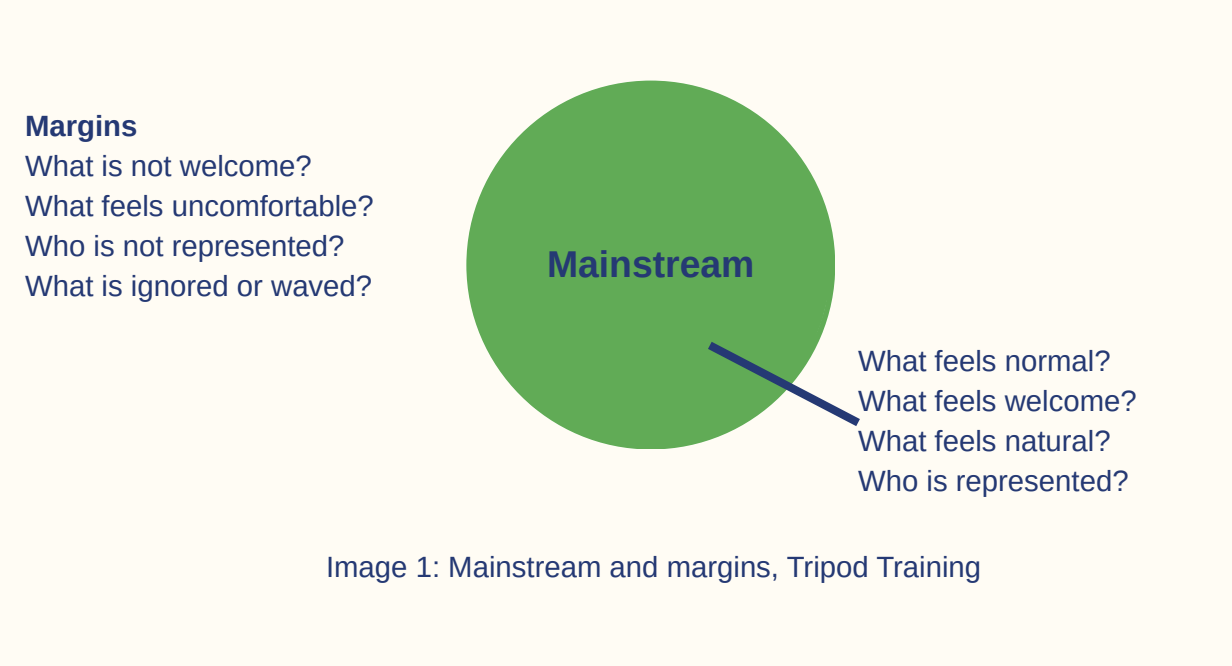
How do you recognise mainstream and margins?Identity and privilege are often seen as static concepts. The mainstream/margin model places more emphasis on context. For example, the margin within a group depends on the group dynamics. While we can often easily identify what the mainstream is in our society, it does not mean that the mainstream and margins are the same in every group. Every group has a culture, regardless of its size, where certain things are considered "good" or "normal, " while others are seen as "wrong", "strange," or "unwelcome" (see image 1). What those things are can vary from group to group. The mainstream involves certain behaviours that may not always be pleasant, visible, or expressible for those in the margins. In a group:
| How (not) to engage with mainstream and margins?Guilt and Shame"Anti-oppression work," "multiculturalism," or "diversity training" often still operate by identifying, judging, and condemning certain forms of mainstream behaviour. This carries the risk of placing those in the margins in a victim role while keeping the focus on the mainstream. A more effective approach focuses on raising awareness among the "unaware" mainstream about their internalised oppression and working toward their liberation from it. This gives those in the margins more space within the group, which not only fosters fair collaboration, where everyone can participate comfortably, but also improves the outcome. After all, no (valuable) perspectives are ignored. It is important to remember that these dynamics occur in almost every group and that ourown mainstream/margin position is fluid. Punishing yourself is not only unnecessary; it also does not lead to (forward-looking) solutions. Charity or solidarity?When people in the mainstream are aware of their position, it does not necessarily lead to sustainable change. The mainstream may, for example, act out of a sense of charity or assume a saviour role. This often happens when the mainstream wants to "help" but is unwilling to (permanently) change the group culture or critically examine itself. This leaves little room for equality, and the mainstream primarily benefits. An alternative is a solidarity perspective, where the mainstream recognises that there are also benefits for them in changing the group dynamics. |
KilljoyPointing out a mainstream/margin dynamic is not always easy and can, for example, be experienced as a "disruption" of the group’s peace. We often want to keep things comfortable.When someone acts as a killjoy, it is important to ask: What is this person actually saying? What reaction does this evoke in me and the group, and why? Be aware of the tendency to react defensively or aggressively, and avoid further marginalising those in the margins or pushing others into the margins. Compassion for one another is crucial to changing the group dynamic. | What can you do? Practical tips:To become aware of positions within a group, you can ask yourself the following questions:
|
Sources
- Training for Change – handout from Daniel Hunter, 2009 (inspiration: Arnold Mindell). Edited by Stroomversnellers for an earlier translation of Tractie
- Toolkit for Creating Brave Spaces. Ulex Project.
- Mainstream and Margins. Tripod Training.
Finally
Interested in attending a training? Contact us here.
This guide is part of the ‘Toolbox for Movements’. This toolbox contains more short digital guides, offering fundamental knowledge about strategy, movement building, campaigning, and organizing.
We also love to learn. So, if you have any ideas for improving or adding to this guide based on your experiences, let us know!