Identifying the issues that motivate people into taking action
This guide is also available in PDF format.
In this guide, you will learn how to choose a topic for a campaign. We explain how to do this together with your supporters or local community. We work with the concept of BOND themes, in Dutch BOND stands for broadly supported, solvable, timely, and deeply felt (Breedgedragen, Oplosbaar, Nu en Diepgevoeld).
BOND issuesPeople become active to improve their lives. The anger over existing problems combined with the hope for change gives them the energy to take action. It is the glue that can hold your diverse community together, despite their different experiences and beliefs. To effectively mobilize people, you need to translate issues that are felt as urgent problems into strategic, actionable goals and vice versa. Curious questions Activation starts with systematically engaging your (potential) community and asking open, curious questions about which issues are deeply felt, while actively listening. This is not just about the content, but also about the emotions, the way, and the specific words people use to express themselves. You might ask questions such as:
| Next, it must be investigated whether an issue enjoys sufficient broad support, rather than it being an issue that only a vocal minority feels emotional about. One way we can do this is by recording the outcome of one-on-one conversations, a survey, or a petition. Whether something is current and urgent depends partly on objective facts that we can list. Is something happening now, or is it pain from the past accompanied by resentment? It is difficult to mobilize people around an issue that cannot be reversed, even if an unjust situation has occurred. However, whether something is urgent is sometimes also a matter of feeling and not always based on clear facts. If the community has accepted a bad situation for a long time, as an organizer you can sometimes help investigate whether there are ways to change it anyway. Finally, this brings us to the strategic consideration: Is this issue solvable?
|
BOND issues per target groupTo identify a BOND issue, it helps to establish a well-defined target group. You then adapt the scale and method accordingly. Flexible contracts might not seem like a BOND issue until you specifically ask people with temporary contracts. Important questions for your organisation are:
Issues that are not BONDJust because issues are not BOND does not mean they are unimportant. They are simply unsuitable for organizing and activating a base. The reason may be that the issues are not collective, making them more suitable for an individual support approach. In such cases, you can use the collective agreements that exist regarding people’s rights and obligations, and apply them to individual situations. Conversely, some matters that initially appear as individual cases may turn out to be BOND issues. For example, if you see more and more people approaching you for help with problems involving a government agency, and all these people have a migration background, then there may be a broader collective issue at play. This is why a healthy interplay between collective and individual advocacy is necessary. | Some examples:
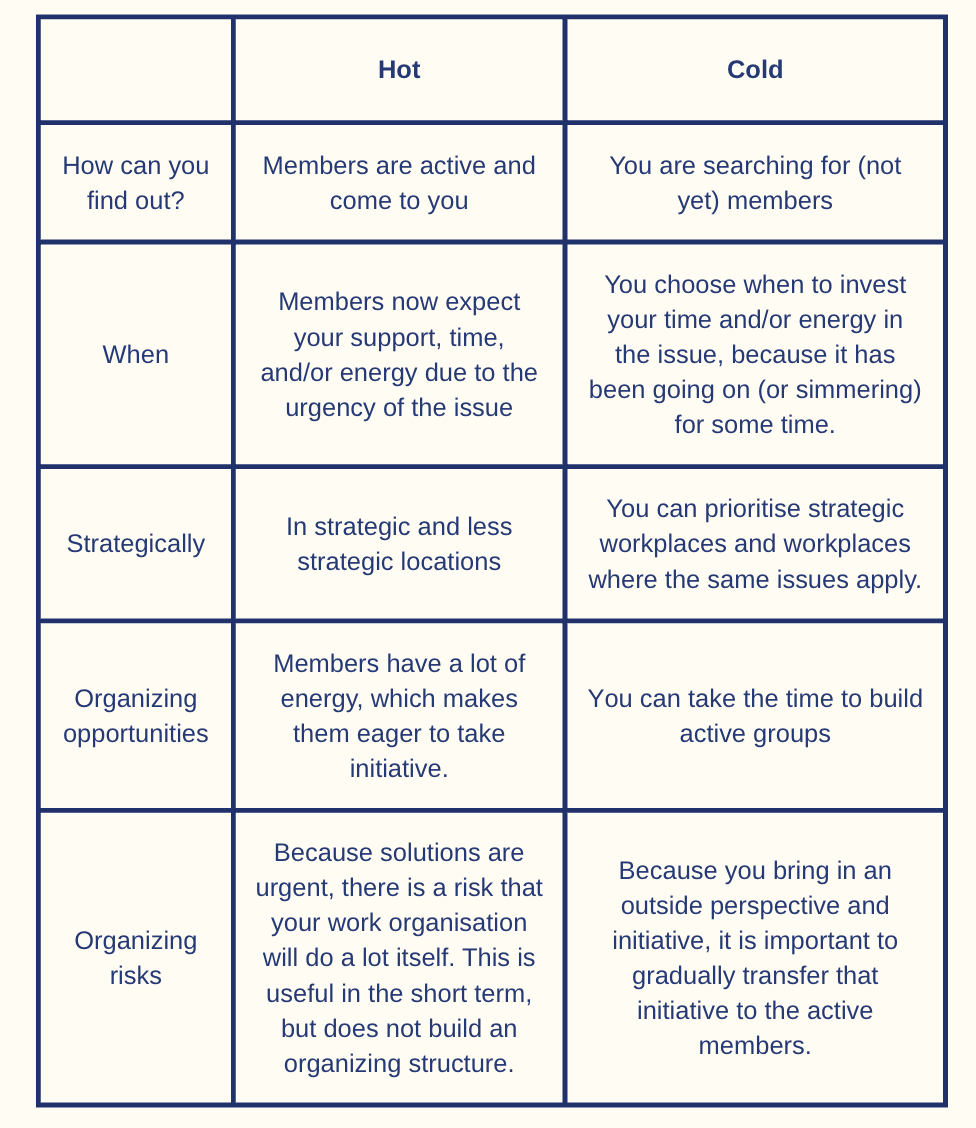
It is also possible that an issue is not BOND because it will only emerge in the future, is not solvable, or does not evoke strong emotion. This does not mean your organisation cannot lobby for it, research it, or simply monitor it. Hot issues and cold issuesWithin the issues that qualify as BOND, a distinction can be made between “hot” and “cold” issues. Simply put, hot issues are urgent, high-intensity problems that people come to you about immediately, while cold issues are those that simmer in the background but, due to a lack of initiative or perspective, have not yet led to tangible change. An example of a “hot” issue is sudden budget cuts that threaten layoffs. Everyone is in a state of alarm and discussing it. Irreversible steps may happen quickly, so there isn’t time to calmly build your campaign structure, it must be addressed immediately. To clarify the difference, we provide a list of examples below. |
Finally
Interested in attending a training? Contact us here.
This guide is part of the ‘Toolbox for Movements’. This toolbox contains more short digital guides, offering fundamental knowledge about strategy, movement building, campaigning, and organizing.
We also love to learn. So, if you have any ideas for improving or adding to this guide based on your experiences, let us know!